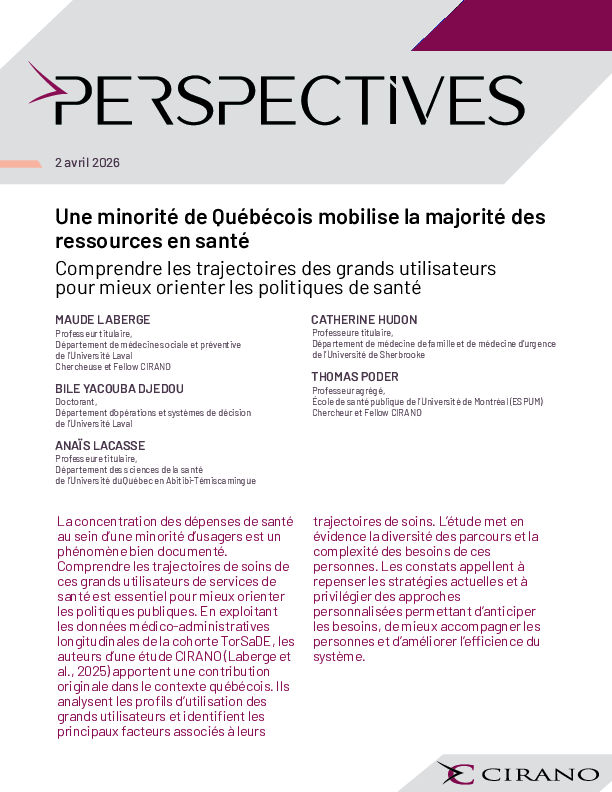
Une minorité de Québécois mobilise la majorité des ressources en santé
The concentration of healthcare expenditure among a minority of users is a well-documented phenomenon. Understanding the care pathways of these “high users” of healthcare services is essential for better guiding public policy.
Drawing on longitudinal medical and administrative data from the TorSaDE cohort, the authors make an original contribution in the Quebec context. They analyze the usage profiles of high-use patients and identify the main factors associated with their care pathways. The study highlights the diversity of pathways and the complexity of these individuals’ needs. The findings call for a rethinking of current strategies and a focus on personalized approaches that enable needs to be anticipated, individuals to be better supported, and the efficiency of the system to be improved.
This study serves as a highly strategic tool for healthcare planning in Quebec. The early identification of high-risk trajectory profiles enables upstream action through targeted interventions before overuse becomes entrenched.