Hazardous materials and regulations
( formatPDF )


To better define hazardous materials and especially for managing, classifications have been established internationally and nationally. Thus, hazardous materials are divided into nine classes according to the type of risk they present to public safety. Most classes are subdivided according to the characteristics of a given product.
Référence : 2008RP-04
Référence : 2008RP-04
Classes
Divisions
Definition
Examples
1.1
Explosives with a mass explosion hazard
TNT
1.2
Explosives with a projection hazard, without risk of explosion
the military shells
1 Explosives
1.3
Materials posing a fire hazard with minor blast or projection
fireworks
1.4
Substances or articles which present no significant hazard to the outside of the package when ignited
safety fuses
1.5
Very insensitive substances with a mass explosion hazard
mine blasting explosives
1.6
Extremely insensitive articles with no mass explosion hazard
EIDS object
2.1
Flammable gases
propane
2 Gases
2.2
Non-flammable, non toxic
azote
2.3
Toxic Gases
Carbon Monoxide
3 Flammable liquids
Flammable liquids
Gasoline and diesel fuel
4.1
Flammable Solids
Safety matches
4 Flammable solids
4.2
Substances liable to spontaneous combustion
charcoal
4.3
Hydro reactive materials
sodium
5 Oxidizers
5.1
Oxidizers
ammonium nitrate
5.2
Organic peroxides
benzoyl peroxide
6 Toxic and Infectious substances
6.1
Toxic substances
Arsenic, cyanide, lead
6.2
Infectious Substances
virus
7 Radioactive materials
Radioactive materials
uranium hexafluoride
8 Corrosives
Corrosives
sulfuric acid
9 Others
Products, Substances or Organisms
Polychlorinated biphenyls, PCBs
Source: Ministère des transports du Québec, 2003, « Guide sur le transport des matières dangereuses », Bibliothèque nationale du Québec, ISBN 2-550-41788-7
Whether in storage or transport, handling of hazardous materials can cause many accidents more or less serious but still difficult to collect and manage. Hazardous substances are usually derived from chemistry and are responsive to their environment. An accident involving HM can affect the environment, property and health. In terms of health, the consequences can quickly become complex and delicate. Here we present evidence of health risks according to different classes of hazardous materials.
Reference: 2008RP-04
Reference: 2008RP-04
Class
Definition
Risks to health
1
Explosives
- A fire will produce irritating, corrosive or toxic
- Ingestion or inhalation may cause serious injury or death
2.1
Flammable gases
- Inhalation may cause toxic effects
- Vapors are extremely irritating
- Contact with the gas can cause serious injury
- A fire will produce irritating, corrosive or toxic
2.2
Nonflammable gas
- Vapors may cause dizziness or asphyxiation
- The gas fumes are heavier than air and spread along ground
- Contact with the gas can cause frostbite
2.3
Toxic Gases
- Can be fatal when inhaled
- Vapors are extremely irritating
- Contact with the gas can cause serious injury
- A fire will produce irritating, corrosive
2.4
Corrosive
- peut être fatal lorsque inhalé
- les vapeurs sont extrêmement irritantes
- le contact avec le gaz peut causer de graves blessures
- un feu produira des gaz irritants, corrosifs
3
Flammable liquids
- Inhalation may irritate or burn skin and eyes
- The fumes can cause dizziness
- A fire will produce irritating, corrosive or toxic
4.1
Flammable Solids
- Ingestion or inhalation may cause serious injury or death
- A fire will produce irritating, corrosive or toxic
- Water from fire control or dilution water may be corrosive or toxic
4.2
Substances liable to spontaneous combustion
- Ingestion or inhalation may cause serious injury or death
- A fire will produce irritating, corrosive or toxic
- Water from fire control or dilution water may be corrosive or toxic
- Some effects may occur following skin absorption
4.3
Hydro reactive materials
- Very toxic, skin contact will produce toxic gas, inhalation may be fatal
- May produce corrosive solutions on contact with water
- A fire will produce irritating, corrosive or toxic
5.1
Oxidizers
- Inhalation, ingestion or contact with vapors, dusts or substance may cause serious injury or death
- Fumes and dust can accumulate in confined areas
- A fire will produce irritating, corrosive or toxic
5.2
Organic peroxides
- A fire will produce irritating, corrosive or toxic
- Ingestion or contact with substance may cause severe injury or burns
6.1
Toxic substances
- Ingestion or inhalation may cause serious injury or death
- A fire will produce irritating, corrosive or toxic
- Water from fire control or dilution water may be corrosive or toxic
- Avoid contact with skin
6.2
Harmful substances
- Ingestion or inhalation may cause serious injury or death
- A fire will produce irritating, corrosive or toxic
- Water from fire control or dilution water may be corrosive or toxic
- Avoid contact with skin
- The Effects of contact may be delayed
8
Corrosives
- Ingestion or inhalation may cause serious injury or death
- A fire will produce irritating, corrosive or toxic
- Water from fire control or dilution water may be corrosive or toxic
- Avoid contact with skin
- The Effects of contact may be delayed
- Avoid contact with skin
9
Miscellaneous Dangerous Goods
- Inhalation may be harmful
- Contact may cause burns to skin and eyes
- A fire will produce irritating, corrosive or toxic
Source: Lalonde, 2004, « Analyse des risques au cours du transport de matières dangereuses à Sherbrooke », MA thesis, University of Sherbrooke
The study concluded that the 1972 intergovernmental regulations concerning hazardous materials consisted of too many laws and regulations not coordinated. It is observed since then real progress in harmonization and concentration in common texts. However, the number of texts are still very important. Notably, the three-tier structure (International, Federal, Provincial) brings additional overlap between those already existing provincial regulations.
This overabundance of regulation raises four types of problems: overlapping of laws, aspects not regulated by law harmonization issues and strategies for circumvention of companies.
Reference: 2006RP-11
This overabundance of regulation raises four types of problems: overlapping of laws, aspects not regulated by law harmonization issues and strategies for circumvention of companies.
Reference: 2006RP-11
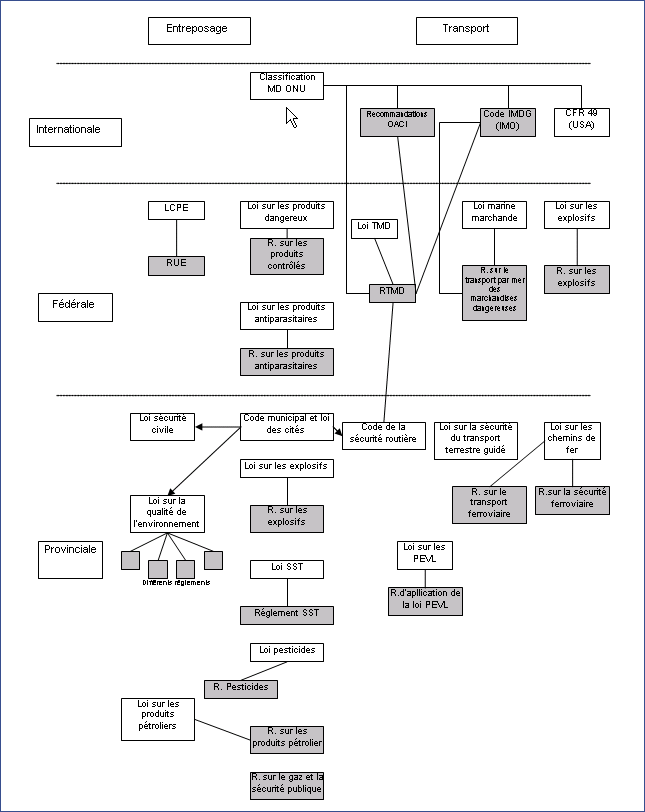
Source: Adapted from Favre, 2006, « Modèle de représentation de la chaîne logistique de matières dangereuses : un essai de représentation plus précise pour la gestion des risques », mémoire thesis Polytechnique de Montreal, July.